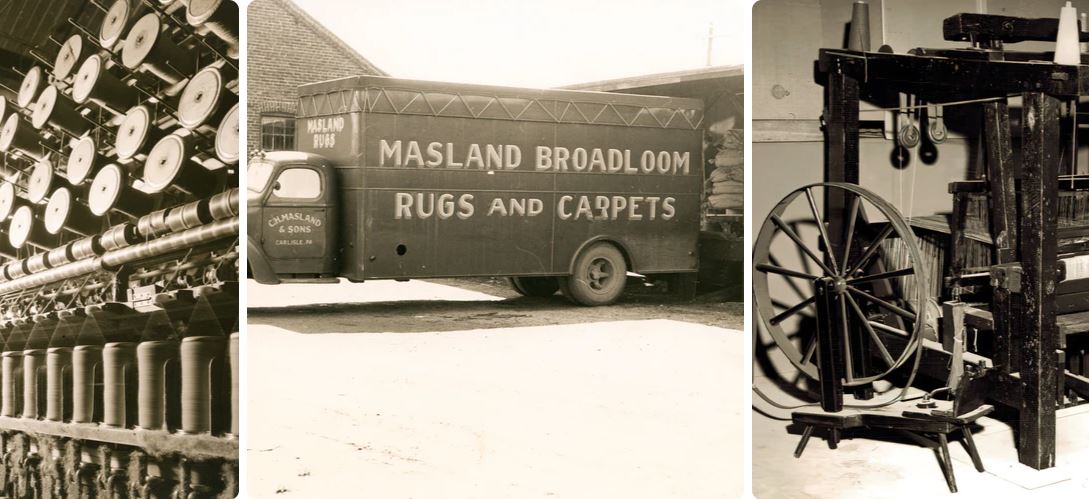
Every great brand has a story—and Masland’s begins over 150 years ago with a returning Civil War soldier, a small dye house, and a vision for something bigger. What started asa modest operation in Pennsylvania grew into one of the most respected names in carpet manufacturing. Today, Masland is known for its luxury, design, and innovation—but its journey is just as impressive as the products it creates.
In the fall of 1864, after being discharged from the Union Army, Charles H. Masland began working at a dyehouse in Germantown, Pennsylvania, under John Tingley. Just two years later, in 1866, Charles, his brother James, and partner Joe Scargle purchased the business—marking the social founding of Masland.
By 1868, Charles and James had acquired an abandoned vinegar plant, transforming it into a thriving dye operation named Allegheny Dye Works, operating as C.H. Masland and Brother.After Charles bought out his brother, the company continued under the name C.H.Masland—establishing the foundation for what would become one of America’s most respected carpet manufacturers.
In 1888, Charles H. Masland purchased Amber Carpet Mills,bringing weaving into the company’s future. His two eldest sons, Maurice H. and Frank E., joined the business, and the name evolved to C.H. Masland and Sons—ushering in a new generation of leadership
By 1898, the company entered the Wilton weaving business,leasing a mill in Mt. Holly, New Jersey, known as the Mt. Holly Brussels & Wilton Carpet Mill. As broadloom carpet and seamless rugs gained popularity, it became clear that multi-story buildings were no longer efficient for production. In 1907, plans began for a new facility designed specifically for the future of weaving.
In 1919, C.H. Masland and Sons purchased the Carlisle, Pennsylvania Fair Grounds, and by 1928, operations had fully relocated to a150,000-square-foot facility. This move positioned the company for major growth.
In 1922, Masland entered the automotive industry, selling woven carpet to the Ford Motor Company—a pivotal milestone that would shape decades of innovation. By the 1950s, Masland developed non-woven, needle-punch carpet for car, truck, and airplane interiors, becoming a leader in automotive floorsystems. The company earned the respect of the world’s largest automobile manufacturers through continuous innovation and technical expertise.
During World War II, following the attack on Pearl Harbor, the entire plant converted to wartime production, weaving cotton duck for military use. In 1943, C.H. Masland and Sons received its first prestigious “E” Award for excellence in production.
The post-war housing boom and the rise of specialty carpet retailers fueled rapid growth. Advertising became central to Masland’s strategy, with print campaigns appearing in publications such as Life, Time,Better Homes and Gardens, House Beautiful, The New Yorker, and Sunset.Television sponsorships included programs like Tales of Tomorrow and appearances on the shows of Gary Moore and Earl Wrightson.
In 1953, Masland organized its first sales division and began selling directly to retailers. By 1965, the company completed its first public offering of common stock, raising capital to expand operations.
In 1966, C.H. Masland and Sons celebrated its 100th Anniversary with more than 2,000 associates in Carlisle—an event said to be the largest dinner gathering ever held in central Pennsylvania at the time.
In 1968, Masland opened a new manufacturing facility in Atmore,Alabama—located at 1968 Carpet Drive—while the Carlisle plant focused on automotive production. The move reinforced Masland’s commitment to large-scale innovation and growth.
In 1986, exactly 100 years after the purchase of Amber Mills,Masland was acquired by Burlington Industries for $117 million, marking the close of the Masland family’s century-long leadership in weaving.
In March 1993, The Dixie Group acquired C.H. Masland and Company. That same year, Masland Contract was founded, expanding the brand’s reach into commercial interiors. The company entered the carpet tile market in 2005, re-entered the wool market in 2007, and reorganized following the 2008 recession to strengthen its long-term vision.
Masland Residential and Contract divisions decentralized in 2004, and Masland Hospitality was founded in 2014 further expanding the brand’s specialized expertise.
What Makes Masland Different?
Even today, Masland stands out for its emphasis on style,craftsmanship, and attention to detail. Key characteristics include:
Designer-inspired patterns
Luxurious textures
Broadloom and custom options
High-end fiber systems
American manufacturing roots
Masland has positioned itself as a premium carpet brand,often chosen for custom homes, boutique spaces, and upscale renovations.
More than 150 years after its founding, Masland remains a trusted name in flooring. The company continues to blend traditional craftsmanship with modern technology, offering carpets that are both beautiful and built to last.
.png)
We are a flooring retailer with over 50 years of experience specializing in both residential and commercial projects. Visit one of our showrooms in Bryn Mawr and Conshohocken or let us bring the same quality products to you with a FREE At-Home Consultation appointment. We provide the absolute best service from start to finish with experienced, courteous, salespeople and top quality installation crews. We carry a wide selection of carpet, hardwood, LVT, tile, and area rugs from the highest quality to the best value so you are sure to find the right product for your needs.

.png)

.png)
Hours For Bryn Mawr
MON-FRI
SAT
SUN
9:30 AM - 6 PM
9:30 AM - 5 PM
11 AM - 4 PM
Hours For Conshohocken
MON-FRI
SAT
SUN
9 AM - 5 PM
9 AM - 5 PM
11 AM - 4 PM